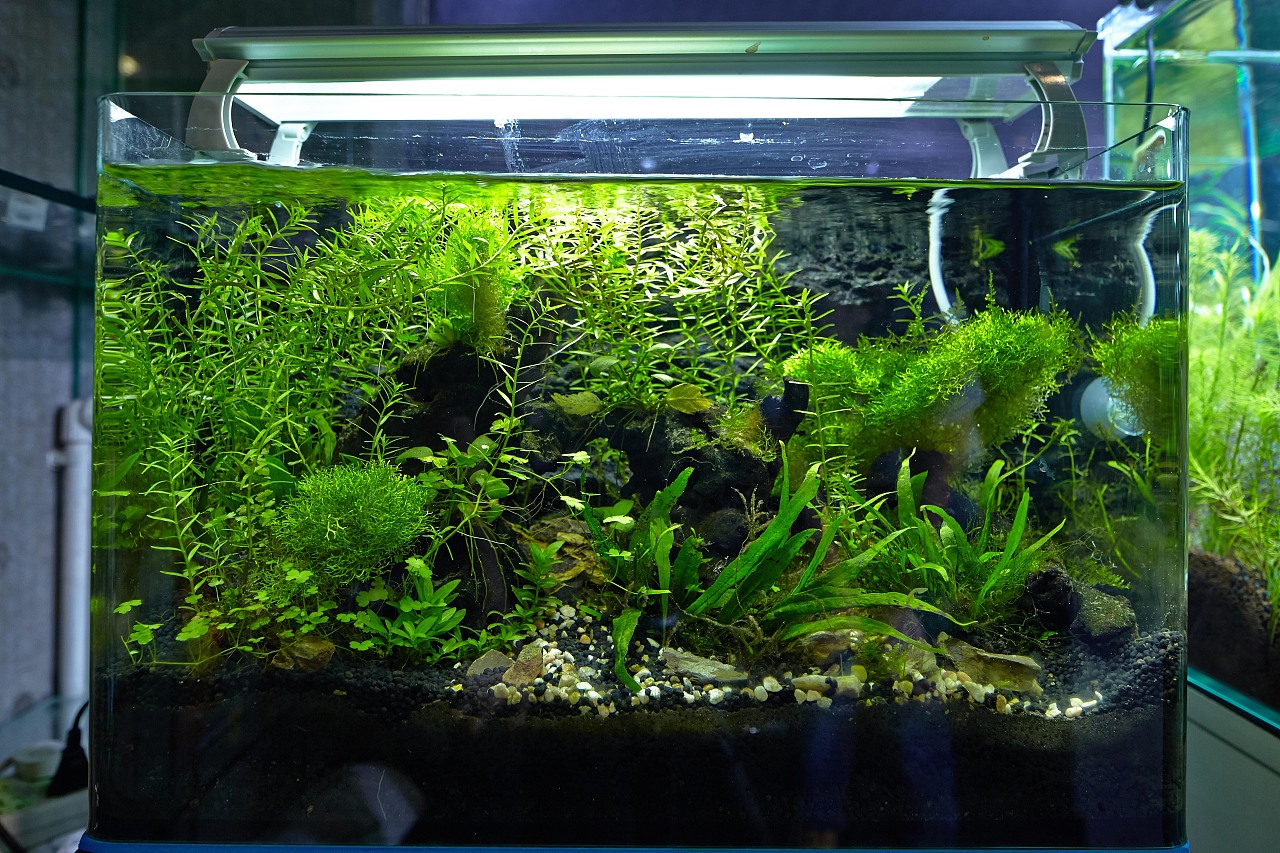
I think the children who live in the countryside or grow up in the countryside should know what plants aquatic plants are. As the name implies, the general aquatic grass is the grass growing in the water. There are many kinds of aquatic plants, which are generally divided into foreground grass, back view grass, middle view grass, clump type water grass, crown type water plant, pepper grass type, water banyan type water plant, moss type water grass, etc. In rural ponds, water and grass can be seen everywhere, and generally grow very thick.
We will often see all kinds of aquatic plants, but in general, we should not be too close to the side of water plants, because snakes and other animals prefer to stay in such an environment. For your own safety, stay away. Some farmers will cut the grass to dry their sheep, which is a good choice, but we must pay attention to safety.
Now, let's learn about the species and characteristics of aquatic plants.
Vallisneria:
Commonly known as noodle grass, Eulaliopsis binata, is an aquatic herb. It has stolon, basal leaves, long and narrow leaves. The length of leaves varies with the depth of water level. The leaves are green and translucent, standing in the water. Strong adaptability to water quality, like weak alkaline water quality, do not like high temperature, cold resistance, like light.
Eulaliopsis lanceolata:
The leaf shape is also like a belt, but it grows upward in a rotating way. From the top of the base, it is very neat and wavy, standing upright in the water, which is very unique and beautiful. It requires more light and does not like high temperature. The suitable temperature is 24 ℃.
Crown grass:
The petiole is thick, the leaves are wide and long, and the plant height is more than 60 cm. It is a gorgeous large-scale aquatic grass. It is native to Brazil and similar to the terrestrial Brazilian, so it should be planted in large aquarium. It is suitable for growing in weak acid and neutral water. It likes temperature and light. The water temperature should be above 24 ℃, and 26-28 ℃ is the best.
Fine leaf crown:
It is a small swamp plant native to Brazil. Lanceolate leaves 10-15 cm long, 1 cm wide, almost no petioles, total height about 20 cm, 2-3 spiral flowers about 1.5 cm in size, with six pistils. The leaves are green and firm, the main veins are clear, and the veins on both sides are not obvious. By bud division propagation, progenies will grow on the reproductive stem of the mother plant. I like strong light. 20-25 ℃ is the best.
Argentinian crown grass: native to Brazil, Guyana and Argentina. The leaves are oval, 15-25 cm long and 10-15 cm wide. It can produce 4-cm-sized flowers with 24 stamens and 0.3-cm-wide fruit. More sunshine is required. The water temperature is 22-28 ℃.
Mini crown:
It is native to Brazil. Lanceolate leaves 5-15 cm long and 0.5-1 cm wide, adapted to different light conditions. Its small size makes it a water plant that can be arranged in aquarium at will. As a prospect grass is better. It should not be planted in coarse sand environment. Iron fertilizer should be supplemented at any time. It propagates on stolon. The water temperature is 22-27 ℃.
Pocket crown:
Small aquatic amphibians of Brazil, Uruguay, and Argentina. Lanceolate, 3-5 cm long and 0.5-1 cm wide. The petiole is 2-3 cm, the root is often red, the flower is 1.5 cm, there are 9 pistils, and the fruit is 0.13 cm. The leaf stems in water are short, 7-12 cm long and 0.5-0.8 cm wide. The light condition was 50W / 100L water. Iron fertilizer should be supplemented. The seed plants were used for bud propagation. The water temperature is 18-28 ℃.
Wave crown:
It is native to southern Brazil. It grows in water with slow flow and low water temperature. Water leaves for lanceolate, 25-35 cm long, 2-3 cm wide, the edge for the wave type, so called wave grass. It has oval aerial leaves, 15 cm long and 9 cm wide, and flowers about 2 cm. The lateral buds on the rhizome are used for propagation. The water temperature should be 22-30 ℃.
Flower crown:
It is native to North America and South America. It belongs to the more common variety. Leaves don't live long. Young leaves narrow, pointed and without petioles. The mature leaves are heart-shaped, 20-30 cm long and 3-4 cm wide, with yellow veins. When the floating field grows, these underwater leaves disappear. It is not resistant to large amounts of light, less than 12 hours a day. In order to maintain the growth of its leaves in water, its leaves should be pruned regularly. Lateral bud propagation. Suitable for weak acid water, 20-26 ℃ water temperature.
Long leaf crown:
Of Central America and southern Brazil. It is a kind of long large ornamental aquatic plants. Lanceolate or elliptic, 15-25 cm long and 3-10 cm wide, very pointed at both ends. The size of the flower is about 1.5 cm and the fruit is 0.2 cm. Soft water and coarse sand environment are needed, and large and high type aquarium or swamp aquarium are needed for planting. The water temperature is 22-28 ℃.
Crown leaf:
Native to Guyana, western Brazil to Argentina. Leaf blade sagittate or cordate, elliptic, 20-30 cm long. Petioles spiny, flowers 3 cm in size. Large aquarium, strong light, fertile foundation and weak acid water quality are needed. The buds on the pedicel are used to propagate. Reproduction is difficult. Suitable for weak acid water, 20-27 ℃ water temperature.
Xiaohaifan:
It is native to the north of South America and the Amazon River Basin. It has heart-shaped leaves from dark green to tawny, with pointed tips supported horizontally by petioles. The leaf blade may be 15-20 cm long and 5-10 cm wide, with 5-7 main veins. As long as they adapt to the environment, they can grow very well under bright light conditions. Its flowers can be seen on the water. Like crown grass, molecular plants propagate. The water temperature is 22-28 ℃.
Red egg:
A highly adaptable weed native to southern Brazil. The height can reach 40-50 cm. It is a mature leaf with reddish color, 30-40 cm long and 4-5 cm wide, with obvious veins and wrinkled edges. The ornamental effect under strong light is excellent, but the supply of fertilizer needs to be strengthened under strong light. Water can't blossom. It can be propagated by using the Progenies from petioles or new shoots from roots. The water temperature is 22-28 ℃.
Elephant Ear:
Aquatic grass of central and southern North America and Mexico. It has strong adaptability and is suitable for planting in large aquarium. Blunt head cordate, 20-25 cm long and 10-15 cm wide. The floating leaves with long stalks grow, but only need to be reduced to maintain the growth of leaves in water. It can produce white flowers on the water surface and bear fruit after artificial pollination. It propagates by lateral buds from stem. The water temperature is 22-28 ℃.
Tiger's ear:
Native to North America, also known as water melon seed vegetable. The leaves are oval in shape and 30 mm in length. Under strong light, the leaves on the top of the stem change from red to brown. Prefer stronger light and lower water temperature. The suitable temperature of aquarium is 16 ~ 24 ℃.
Water plantain:
It is also known as water cabbage. Its leaves are submergent, basic, light green, thin and transparent. Flowers bloom on the water surface and grow in ponds, lakes and slow flow ditches. They are distributed in East China, Guangdong and Guangxi.
After knowing so much about the species and characteristics of aquatic plants, I'm not impressed. These plants generally have strong adaptability, like weak alkaline water quality, cold resistance, light. Generally, the temperature suitable for their growth is about 20 ℃. Some aquatic plants need a higher temperature environment, and the highest temperature can reach above 28 ℃. And the distribution of water and grass is extensive.